Peptide Reconstitution with Bacteriostatic Water: How It Works
On this page
- Reconstitution means dissolving a freeze-dried (lyophilised) solid in a compatible liquid diluent so it can be measured as a solution.
- The arithmetic is one relationship: concentration equals content divided by volume — mg in the vial ÷ mL of diluent added = mg/mL.
- The diluent volume chosen changes the concentration of the solution, never how much material is in the vial.
- On a U-100 insulin syringe, one printed unit corresponds to 0.01 mL — the scale is a volume scale in disguise.
- Which diluent a preparation requires, and every question of preparation and use, belongs with its product information and a qualified professional — not this article.
Search interest in how to reconstitute peptides with bacteriostatic water is really interest in three separate questions: what reconstitution is, what the numbers mean, and what to do at the bench. This article answers the first two in full — the vocabulary and the arithmetic — because they are questions of fact. The third is not ours to answer: preparation and use belong with the product information of whatever is being prepared and a qualified professional, and nothing here is a procedure.
What reconstitution is
Peptides are commonly supplied lyophilised — freeze-dried into a solid cake or powder inside a sealed vial, because most peptides are far more stable stored dry than in solution. A solid can be weighed but not drawn up or measured by volume, so before a lyophilised product can be used for anything it is reconstituted: dissolved in a compatible liquid, called a diluent, turning a stated mass into a solution with a measurable concentration. Why peptides arrive freeze-dried in the first place is covered in what peptides are.
The diluent contributes no active ingredient. It is the solvent — and which liquid is compatible with a given preparation is stated in that product's own information, not something a retailer can tell you. What we can describe is the arithmetic, because it is the same for any solution ever mixed.
The one equation
Everything in reconstitution arithmetic is a single relationship:
concentration = content ÷ volume
The content is the mass stated on the product's label, in milligrams. The volume is the diluent added, in millilitres. Divide one by the other and the result is the solution's concentration in mg/mL. Three worked examples with a hypothetical 5 mg vial of lyophilised material:
| Stated content | Diluent added | Resulting concentration | Per 0.01 mL |
|---|---|---|---|
| 5 mg | 1 mL | 5 mg/mL | 50 µg |
| 5 mg | 2 mL | 2.5 mg/mL | 25 µg |
| 5 mg | 2.5 mL | 2 mg/mL | 20 µg |
The last column is the same number expressed per hundredth of a millilitre, which matters in the next section but one. Note the milligram–microgram step: 1 mg is 1,000 µg, and mixing the two units is the most common arithmetic slip in this topic.
Volume changes strength, not content
The table above shows the point people most often miss: adding more diluent does not change how much material is in the vial. The 5 mg is 5 mg whether it is dissolved in 1 mL or 3 mL. What changes is how spread out it is — the concentration — and therefore what any given volume of the solution contains. More diluent means a weaker solution where each 0.01 mL holds less; less diluent means a stronger one where each 0.01 mL holds more. Neither is more "correct" as arithmetic; the practical constraint is simply the vial's own capacity and whatever the preparation's product information specifies.
What U-100 markings measure
A 0.5 mL U-100 insulin syringe — the kind in our 20-pack — is graduated 0 to 50 in printed units. U-100 describes the printed scale, not the syringe: the barrel is marked for a liquid at 100 units per millilitre, so one printed unit corresponds to 0.01 mL and the 50-unit barrel holds 0.5 mL. The scale is a volume scale in disguise.
That is the entire connection between syringe markings and the arithmetic above: a graduation is a fixed volume, and what that volume contains depends only on the concentration of whatever solution is in the barrel. The markings know nothing about the solution. Full specifications of the syringe itself — gauge, graduations, standards — are in insulin syringe sizes explained.
Why searches say “with bacteriostatic water”
The phrase reconstitution with bacteriostatic water is so common that it is worth being precise about what the bacteriostatic part contributes — and what it doesn't. Bacteriostatic water (BAC water) is sterile water with 0.9% benzyl alcohol as a preservative. In a reconstitution context it behaves exactly as any water does: it dissolves. The preservative changes nothing about the arithmetic above and adds no active ingredient; what it changes is the diluent vial's own label, which can say multi-dose because the preservative holds bacterial growth in check inside the sealed vial between entries.
That labelling is the whole association between the word bacteriostatic and the word reconstitution: material prepared and used across days rather than minutes pairs naturally with a diluent vial labelled for repeated entry. It is a fact about vials and calendars, not a recommendation — and it does not make the two diluent presentations interchangeable, which is the next section's point.
Which diluent — and whose call it is
The two diluent presentations peptide buyers compare are bacteriostatic water and sterile water, and the difference is on their labels: preservative-free sterile water is labelled for a single withdrawal, while bacteriostatic water's 0.9% benzyl alcohol lets the manufacturer label the sealed vial multi-dose — the reason solutions used across days rather than minutes are associated with the bacteriostatic presentation. Some preparations' product information specifies bacteriostatic sodium chloride 0.9% instead.
Which of them a particular preparation requires is not a choice this article can make. It is stated in that product's own information, and it is a question for a qualified professional. What we sell is the diluent presentations themselves — factory-sealed, in the manufacturer's or our own labelled vials — not guidance on their therapeutic use.
After reconstitution
Two facts about the solution's life are worth knowing regardless of anything else. First, the clock: once a multi-dose diluent vial's stopper is first entered, its in-use period runs on the calendar — 28 days is the figure commonly stated for benzyl-alcohol-preserved presentations, and the supplied product information governs; the detail is in expiry and in-use dating. Second, the look: a solution that turns cloudy, discoloured or particulate fails inspection whatever the dates say, and the diluent is rarely the cause — what cloudiness actually tells you covers the usual reasons.
Doing the arithmetic by hand
No calculator is needed — reconstitution arithmetic is one division and one unit conversion, done in this order:
- Divide content by volume. The mass stated on the label, in mg, divided by the millilitres of diluent added, gives mg/mL. 10 mg into 2 mL is 5 mg/mL; the same 10 mg into 4 mL is 2.5 mg/mL.
- Convert once, carefully. 1 mg is 1,000 µg, so 5 mg/mL is 5,000 µg/mL. Do this as its own written step — dropping or adding a zero here is the classic slip in this arithmetic.
- Restate per graduation if you need to. One printed unit on a U-100 scale is 0.01 mL — one hundredth of a millilitre — so divide the µg/mL figure by 100. At 5,000 µg/mL, each 0.01 mL of solution contains 50 µg.
- Check it backwards. Multiply your per-graduation figure by 100 and it must land back on the µg/mL figure; multiply mg/mL by the volume added and it must land back on the label's stated mass. If either check fails, a conversion slipped.
These are properties of the numbers, not directions: what any of the figures should be for a given preparation, and everything about actually preparing one, belongs with its product information and a qualified professional.
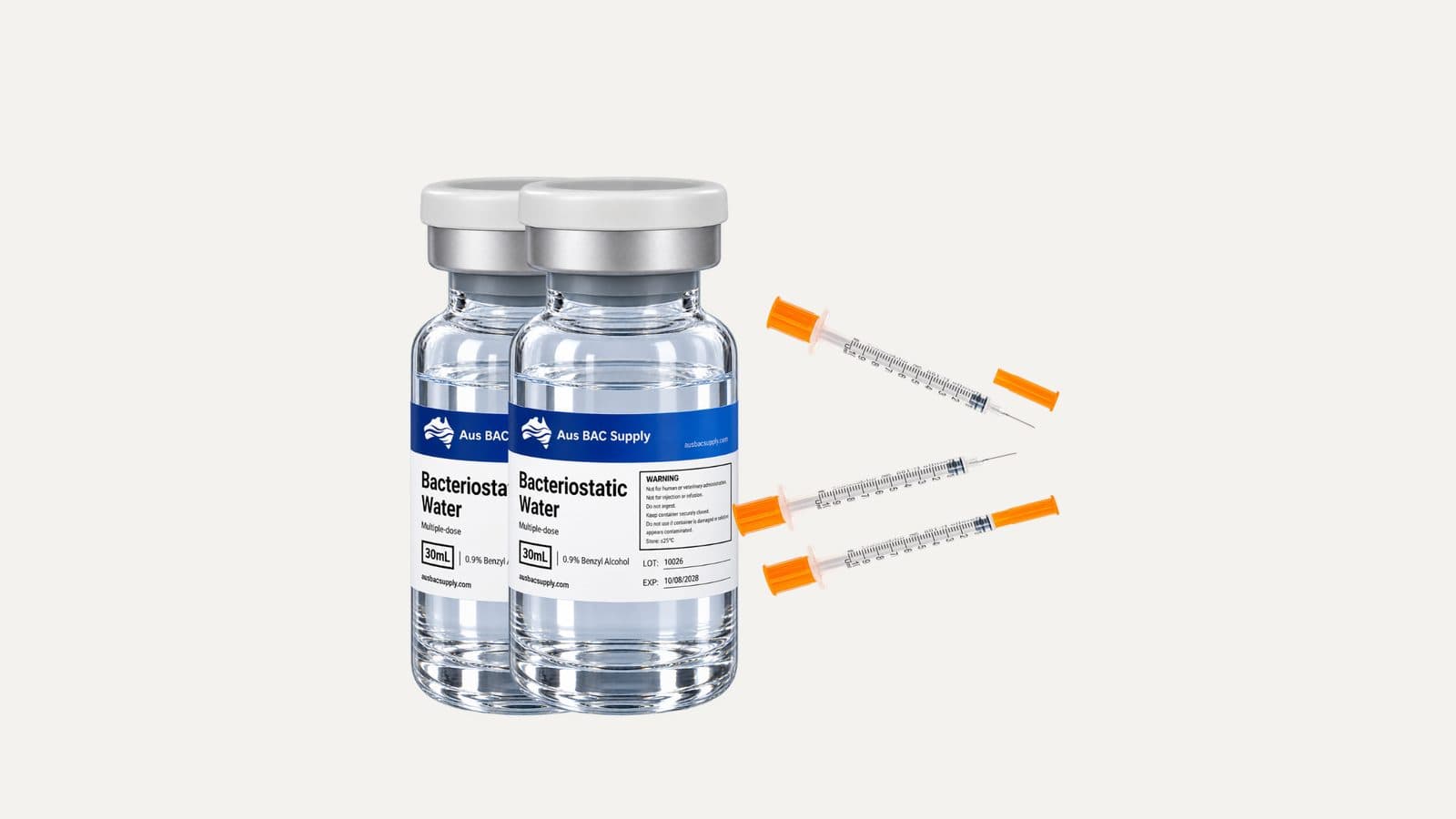
BAC water + syringes, as one kit
Two 30 mL multi-dose vials with a sealed 20-pack of U-100 syringes, factory-sealed and dispatched from Melbourne.
See the 2-item kit →Frequently asked questions
How do you reconstitute peptides with bacteriostatic water?
The mechanics of preparation are a question for the preparation's own product information and a qualified professional — this site does not provide reconstitution or administration instructions. What can be stated as fact: reconstitution means dissolving the lyophilised solid in a compatible diluent, the resulting concentration is the stated mass divided by the volume added (mg ÷ mL = mg/mL), and bacteriostatic water's preservative changes the diluent vial's own multi-dose labelling, not the arithmetic.
What does it mean to reconstitute a peptide?
To dissolve the freeze-dried (lyophilised) solid in a compatible liquid diluent so it becomes a solution with a measurable concentration. The diluent contributes no active ingredient; which diluent is compatible is stated in the preparation's own product information.
How much bacteriostatic water do you add to a peptide vial?
There is no single figure, because the volume added sets the solution's concentration rather than being right or wrong in itself: concentration = mg in the vial ÷ mL added. Any constraint on the choice belongs to the preparation's product information and a qualified professional — we publish the arithmetic, not preparation directions.
Does adding more diluent weaken a peptide?
It lowers the concentration — each millilitre of solution contains less — but the total content in the vial is unchanged. 5 mg dissolved in 3 mL is the same 5 mg as in 1 mL, spread through three times the volume.
What do the units on a U-100 insulin syringe measure?
Volume. The U-100 scale marks the barrel for a liquid at 100 units per millilitre, so one printed unit corresponds to 0.01 mL. What that volume contains depends entirely on the concentration of the solution in the barrel — the markings say nothing about the solution itself.
Should peptides be reconstituted with bacteriostatic water or sterile water?
The two carry different labels — sterile water is single-withdrawal, bacteriostatic water is labelled multi-dose — and they are not interchangeable by assumption. Which one a given preparation requires is stated in its product information and is a question for a qualified professional, not a retailer.
How long does a reconstituted solution last?
That is a property of the prepared product and its product information, not of the diluent alone. What the diluent's own label does say is that an opened multi-dose vial has a finite in-use period — commonly stated as 28 days for benzyl-alcohol-preserved presentations — and that any vial failing visual inspection fails regardless of dates.
Sources
- Therapeutic Goods Administration — Australian Government Department of Health and Aged Care
Products discussed in this article are for non-therapeutic purposes only. Not for human or veterinary therapeutic use. Never inject, ingest or self-administer. This article is general information only, not medical or veterinary advice, and does not provide instructions for therapeutic preparation or administration. Aus BAC Supply is an independent retailer and is not affiliated with, endorsed by or an authorised distributor of the manufacturer; the name identifies the genuine factory-sealed product supplied.