Insulin Syringe Sizes Explained: Units, Gauge and Length
On this page
- Three numbers describe an insulin syringe: barrel capacity, needle gauge and needle length.
- U-100 is a graduation scale, not a size — it means the barrel is marked in units for U-100 strength fluid.
- Gauge runs backwards: a higher gauge number is a thinner needle.
- A smaller barrel is easier to read at small volumes, which is the usual reason to choose one.
- Aus BAC Supply supplies syringes as lab consumables; selection and use are matters for a qualified professional.
An insulin syringe is described by three numbers, and the labelling convention makes two of them counter-intuitive. This is a guide to reading the specification — what the figures on the packet mean and how they relate. It is not a guide to selecting or using one, which is a matter for a qualified professional.
Three numbers
Every insulin syringe specification is some combination of:
- Barrel capacity, given in units — 30, 50 or 100 — and sometimes also in millilitres.
- Needle gauge, a number describing the needle's outside diameter, written as 29G, 30G, 31G and so on.
- Needle length, in millimetres, commonly between 4 mm and 13 mm.
A packet described as "1 mL U-100, 29G x 13 mm" has given you all three. Take them one at a time.
What U-100 means
This is the figure most often misread as a size. U-100 is a graduation scale. It means the barrel is marked in units calibrated for fluid at U-100 strength, where 100 units occupy 1 mL. So on a U-100 syringe, 1 unit of scale equals 0.01 mL of volume, and the scale and the volume are locked to each other by that ratio.
Two consequences follow. A U-100 syringe holding "100 units" holds 1 mL. And the unit markings are only meaningful for U-100 strength fluid — reading a unit scale against something at a different concentration is simply reading the wrong scale.
Barrel capacity
The three common barrels are 0.3 mL (30 units), 0.5 mL (50 units) and 1 mL (100 units). The trade-off is resolution against capacity: the same 100 units of scale, printed along a shorter barrel, gives finer-spaced markings that are easier to read accurately at small volumes. A 1 mL barrel covers more in one draw but crowds its graduations.
This is the usual reason one barrel is preferred over another — legibility at the volume actually being measured, rather than capacity for its own sake.
Gauge runs backwards
Needle gauge is the one specification that behaves opposite to intuition: a higher gauge number means a thinner needle. A 31G needle is finer than a 29G. The convention descends from wire-drawing, where the number counted drawing passes rather than measuring diameter directly, and it has stuck.
Thinner is not automatically better. A finer needle has a narrower bore, so fluid moves through it more slowly — which is noticeable with a viscous fluid and irrelevant with a watery one.
Needle length
Given in millimetres, typically 4 mm to 13 mm on insulin syringes. Unlike gauge, this number is literal: 8 mm is longer than 6 mm. Length is quoted alongside gauge because the two together describe the needle, and a specification that gives only one is incomplete.
What we supply
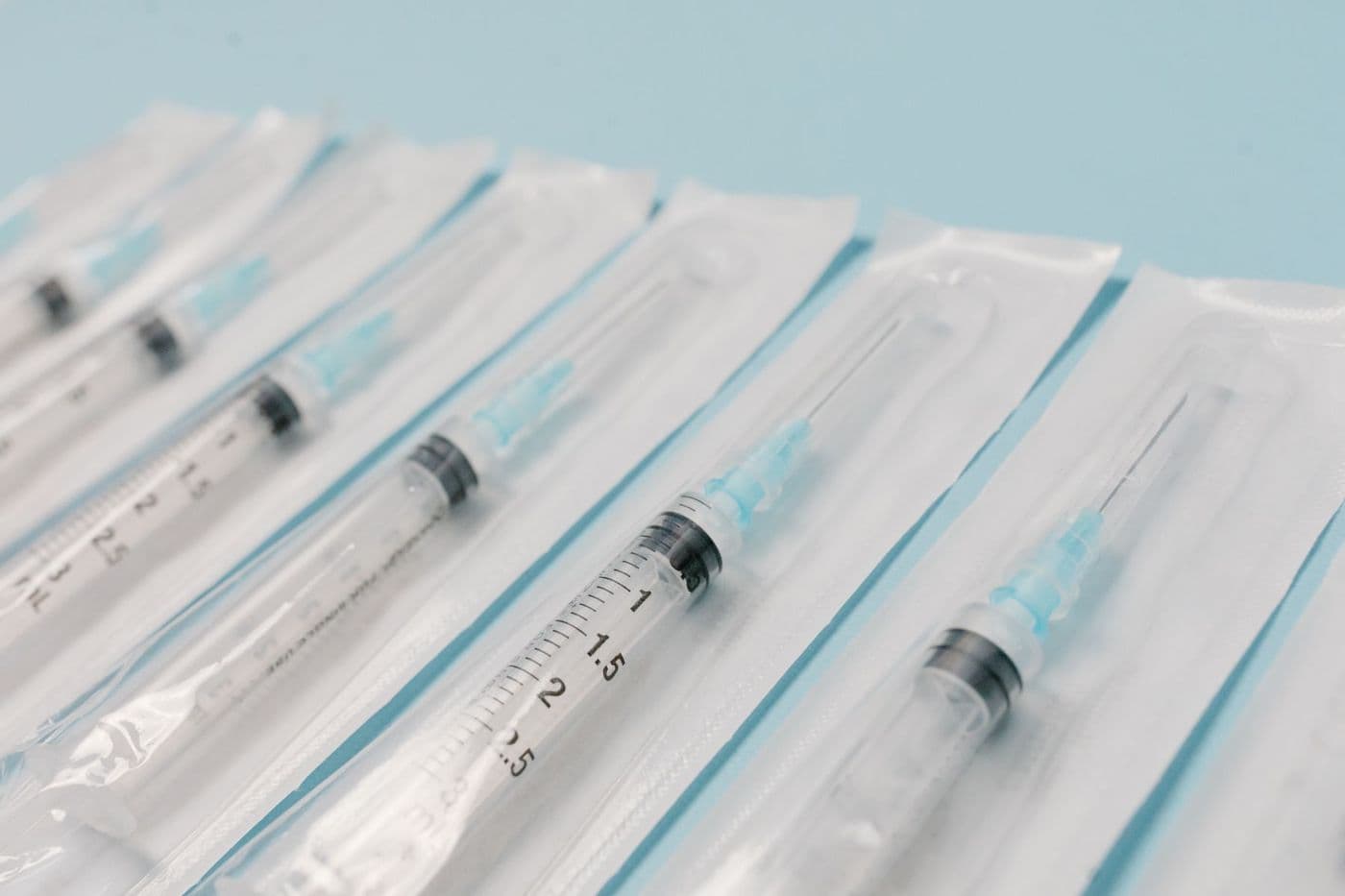
Aus BAC Supply stocks insulin syringes in 20-packs as a laboratory consumable, individually wrapped and sterile, and also as part of a starter kit paired with bacteriostatic water. The full specification for the pack we carry is on the product page rather than summarised here, so what you read is the specification of the item actually in stock.
We supply these as lab consumables and do not advise on selection or use. Which syringe is appropriate for any given task, and whether a task is appropriate at all, is a matter for a qualified professional working from the relevant product information. Products supplied by Aus BAC Supply are not for human or veterinary therapeutic use.
Insulin syringes, individually wrapped
Sterile single-use syringes in 20-packs, dispatched from Melbourne with tracked Australia-wide delivery.
Shop syringes →Frequently asked questions
What does U-100 mean on a syringe?
It is a graduation scale, not a size. The barrel is marked in units calibrated for fluid at U-100 strength, where 100 units occupy 1 mL — so one unit of scale corresponds to 0.01 mL.
Is a higher gauge needle thicker or thinner?
Thinner. Needle gauge runs backwards: a 31G needle is finer than a 29G. The convention comes from wire-drawing, where the number counted drawing passes rather than measuring diameter.
What is the difference between a 0.5 mL and a 1 mL insulin syringe?
Capacity and resolution. A 0.5 mL barrel holds 50 units and a 1 mL barrel holds 100, but the shorter barrel spaces its graduations further apart, which makes small volumes easier to read accurately.
How many units are in 1 mL?
On a U-100 syringe, 100 units. That ratio is what the U-100 scale means, and it holds only for fluid at U-100 strength.
Does Aus BAC Supply advise on which syringe to use?
No. We supply syringes as laboratory consumables. Selection and use are matters for a qualified professional working from the relevant product information.
Sources
- ISO 8537 — Sterile single-use syringes, with or without needle, for insulin — International Organization for Standardization
Products discussed in this article are for non-therapeutic purposes only. Not for human or veterinary therapeutic use. Never inject, ingest or self-administer. This article is general information only, not medical or veterinary advice, and does not provide instructions for therapeutic preparation or administration. Aus BAC Supply is an independent retailer and is not affiliated with, endorsed by or an authorised distributor of the manufacturer; the name identifies the genuine factory-sealed product supplied.