In stock
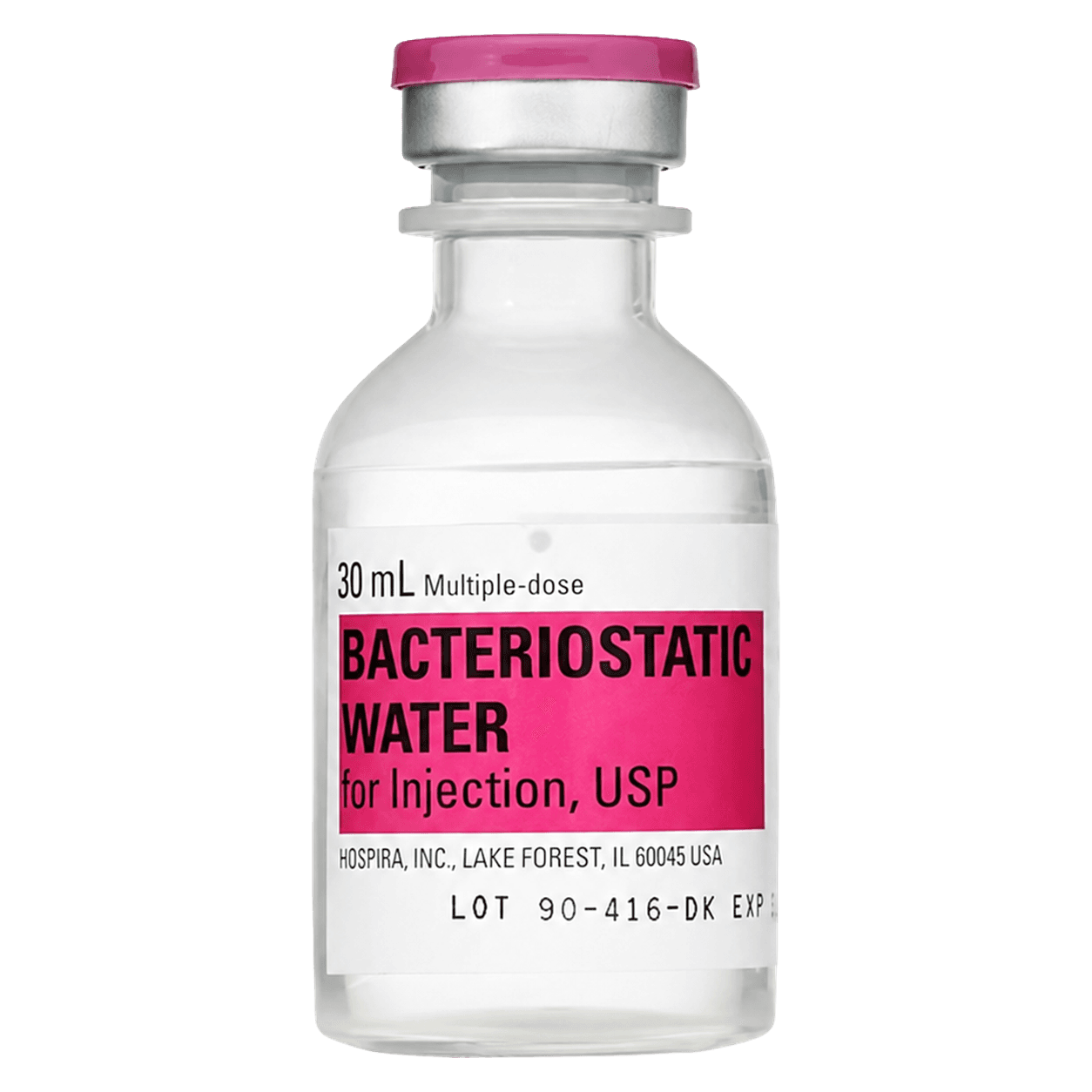
Representative image. Supplied vial labelling, lot and expiry details may vary.
Original manufacturer presentation · use per supplied PI
Bacteriostatic Water
Hospira Bacteriostatic Water for Injection USP — 30 mL
Medical-grade bacteriostatic water (BAC water) in its original manufacturer presentation.
Manufactured by Hospira
Australian stock
Dispatched from Melbourne
Quantity · 30 mL vials
Save up to 15%$38.99
1 vial × 30 mL$38.99 per vial
AUD · INC. GST
Need syringes too? View the bundle · $82.99 →
Manufacturer-labelled medical-grade bacteriostatic water (BAC water), supplied in its original presentation. Labelled as a diluent or solvent for compatible medicines that require preparation before injection.
Product details
- Original manufacturer seal, vial and label
- No decanting, repacking or relabelling by Aus BAC Supply
- Labelled diluent or solvent for preparation of compatible medicines
- Supplied product information and clinician direction govern use
- 0.9% (9 mg/mL) benzyl alcohol bacteriostatic preservative
- Manufacturer's 30 mL glass multi-dose vial, flip-off seal intact
- Released against the Bacteriostatic Water for Injection USP monograph
- Singles, 2- and 3-vial packs, and trays of 25 and 50
- Dispatched from Melbourne — same business day before 1pm
Secure checkout




 PayIDBank
PayIDBankOverview
This is an original manufacturer presentation of bacteriostatic water (BAC water), manufactured by Hospira. Aus BAC Supply keeps the manufacturer seal, vial and label unchanged.
Bacteriostatic water is commonly shortened to BAC water; both names describe this same product.
It is a diluent or solvent—not a ready-to-administer medicine. The supplied product information determines compatibility, preparation, route, handling and storage. Clinical decisions and administration must be directed by a qualified healthcare professional.
Never inject a diluent by itself or use it outside the manufacturer instructions.
The 0.9% figure on the label is the benzyl alcohol concentration — 9 mg per mL — and it is the whole reason this presentation exists in a multi-dose vial at all. Benzyl alcohol is a bacteriostatic agent: it inhibits the growth of most common bacteria rather than sterilising anything, which is what allows a sealed vial to be entered more than once instead of being discarded after a single withdrawal. Preservative-free sterile water has no such agent, and its vial is labelled for one withdrawal for exactly that reason.
That protection is finite rather than open-ended. A printed expiry governs the sealed vial, and a separate, much shorter in-use period begins the moment the stopper is first entered — whichever falls first ends the vial's usable life. Both figures come from the product information supplied with the vial, not from a general reference.
What you receive is the manufacturer's own 30 mL glass multi-dose vial with its flip-off closure and crimp intact, manufactured under pharmaceutical GMP and released against the Bacteriostatic Water for Injection USP monograph — a specification covering identity, sterility, preservative content, particulate limits and a controlled pH range, with a lot number and expiry traceable to that release. Aus BAC Supply does not decant, repackage or relabel. That distinction is the point: water of unclear origin transferred into an unmarked container has none of the documented manufacturing behind it, however similar it looks in the vial.
Available as a single vial, in 2- and 3-vial packs, and in manufacturer trays of 25 and 50. Unopened vials keep until their printed expiry, so buying several at once lowers the unit price without shortening anything — each vial's in-use period starts only when that particular vial is opened.
Aus BAC Supply is an independent retailer and is not affiliated with, endorsed by or an authorised distributor of the manufacturer; the name identifies the genuine factory-sealed product supplied.
Specifications
ProductHospira Bacteriostatic Water for Injection USP
ManufacturerHospira
StandardBacteriostatic Water for Injection USP — manufactured and released against the USP monograph, which sets a controlled pH range alongside identity, sterility, preservative content and particulate limits.
Available sizes30 mL, 2 vials, 3 vials, 5 vials, Tray of 25, Tray of 50
GradeOriginal manufacturer presentation · use per supplied PI
DirectionsNot a ready-to-administer medicine. Use only as a diluent or solvent where the supplied manufacturer information and a qualified healthcare professional specify it. Never inject by itself or self-administer.
StorageFollow the storage, handling, beyond-use and disposal requirements printed on the vial and in the supplied manufacturer product information.
UseDiluent or solvent for compatible medicines requiring preparation before injection; follow the supplied product information
Dispatched fromMelbourne, Australia
FAQ
What is this presentation for?
It is labelled as a diluent or solvent for compatible medicines that require preparation before injection. It is not a ready-to-administer medicine and must not be injected by itself.
Has Aus BAC Supply changed the product?
No. We keep the original manufacturer seal, vial and label intact and do not decant, repackage or relabel it.
What is bacteriostatic water?
Sterile water containing 0.9% (9 mg/mL) benzyl alcohol as a bacteriostatic preservative. The preservative inhibits the growth of most common bacteria, which is what allows a sealed multi-dose vial to be accessed repeatedly rather than discarded after a single withdrawal.
Is BAC water the same as bacteriostatic water?
Yes. BAC water is simply the common abbreviation. You may also see it written as bacteriostatic water for injection, BWFI or bac water — all describe the same product.
How is it different from sterile water?
Sterile water carries no preservative, so its vial is labelled for a single withdrawal and should not be re-entered. Bacteriostatic water adds 0.9% benzyl alcohol, which holds bacterial growth in check after the seal is broken and is what makes a multi-dose presentation possible.
How is it different from bacteriostatic saline?
Both are preserved with benzyl alcohol and both are multi-dose vials. Bacteriostatic saline is isotonic 0.9% sodium chloride; bacteriostatic water contains no solute. The manufacturer information for the product being prepared specifies which diluent it requires.
What does the 0.9% refer to?
The benzyl alcohol concentration — 9 mg per mL. Note that on a bacteriostatic sodium chloride label the 0.9% refers to the salt instead, which is a common source of confusion between the two products.
How long does bacteriostatic water last once opened?
A fixed in-use period applies from first entry, and it is much shorter than the printed expiry on the sealed vial. The figure stated in the product information supplied with your exact vial is the one that governs, and whichever date falls first ends the vial's usable life.
How many times can a multi-dose vial be used?
The label sets an in-use period rather than a number of entries — a multi-dose vial may be entered repeatedly within that window under aseptic technique, and is discarded when the period ends or the solution fails inspection, whichever comes first. Inspect before every entry: a vial that is cloudy, discoloured or carries visible particles is not used regardless of dates.
Can I buy bacteriostatic water at a chemist in Australia?
Usually not. Most community pharmacies do not routinely stock multi-dose bacteriostatic presentations, so Australian buyers generally order online. We dispatch from Melbourne, same business day before the 1 pm cutoff, with tracked delivery Australia-wide.
What is bacteriostatic water used for?
It is labelled as a diluent or solvent — a liquid for preparing compatible medicines that require reconstitution before injection. It is not a ready-to-administer medicine and is never injected on its own. The product information for whatever is being prepared specifies which diluent that product requires.
What does BAC stand for?
Bacteriostatic. BAC water is the common shorthand for bacteriostatic water, and you will also see it written as bacteriostatic water for injection, BWFI or bac water — all the same product.
Does it need to be refrigerated?
Follow the storage conditions printed on the vial and in the supplied manufacturer product information. Storage conditions do not extend the in-use period once a vial has been entered.
What size is the Hospira bacteriostatic water vial?
30 mL. It is the manufacturer's 30 mL multiple-dose plastic vial, supplied factory-sealed, and the manufacturer packs it in trays of 25. The manufacturer's label also lists a 20 mL glass presentation, which is not stocked here.
What sizes and pack quantities are available?
The 30 mL multi-dose vial as a single, in 2-, 3- and 5-vial packs, and in manufacturer trays of 25 and 50. Every option is the same factory-sealed vial — the pack size is simply how many you receive.
Do you sell Hospira bacteriostatic water in 10 mL or 20 mL?
No. The manufacturer-labelled vial stocked here is the 30 mL. Bacteriostatic water in 10 and 20 mL multiple-dose vials is stocked under the Aus BAC Supply own label, which is a separate line with its own labelling.
Is it manufactured to a standard?
Yes. It is produced under pharmaceutical GMP and released against the Bacteriostatic Water for Injection USP monograph, which sets a controlled pH range alongside identity, sterility, preservative content and particulate limits.
How fast is delivery in Australia?
Orders placed before 1 pm Melbourne time on a business day are dispatched the same business day, tracked Australia-wide. Express typically arrives within 1–3 business days and Standard within 2–6 after dispatch; estimates are a guide and are not guaranteed. Standard shipping is free on orders over $200, and express is $5 on those orders.
Customer reviews
5 out of 5 · 36 reviews, all from verified orders. Collected from every buyer and published good or bad — spam is the only filter.
1 of 36
Learn more
- Hospira bacteriostatic water in New Zealand, priced in NZD
- What is BAC water?
- What does bacteriostatic mean?
- How reconstitution works: the arithmetic explained
- Bacteriostatic water vs sterile water
- How the 0.9% benzyl alcohol preservative works
- How long does bacteriostatic water last?
- How to store bacteriostatic water
- Cloudy vial? What to check before use
- Cloudy after reconstitution: what it means
- Vial sizes and pack quantities
- Where to buy BAC water in Australia
- What drives the price in Australia
- How many times can you use a multi-dose vial?
- How to read a vial label
- What does USP mean on a vial?
- Insulin syringe sizes explained
- All bacteriostatic water (bac water)
- Product documentation: manufacturer product information, safety data sheets and standards
- Bacteriostatic saline (0.9% sodium chloride)